

Introduction
Local customers are searching online for nearby services, trusted professionals, reliable businesses, and solutions to their immediate problems. Whether someone searches for a plumber near me, the best digital marketing agency in Texas, a local dentist, or a home remodeling company in their city, appearing prominently in relevant search results can make a meaningful difference to a business’s growth.
However, establishing a strong local search presence requires more than adding a business address to Google or publishing a few location-based keywords. Businesses need accurate listings, a well-optimized website, authentic customer reviews, useful local content, consistent business information, and a strategy that converts online visibility into real inquiries.
This is where professional local SEO services and Google Business Profile optimization become valuable.
Meta Web Pro provides digital solutions that include search engine optimization, website development, and digital marketing. Businesses looking to strengthen their online presence can explore its services at Meta Web Pro and assess how a coordinated digital strategy can support their local marketing objectives.
In this comprehensive guide, we explain how local SEO works, what makes Google Business Profile optimization effective, how businesses can improve their Google Maps visibility, and what to look for when choosing a local SEO company in the United States.
What Is Local SEO, and Why Does It Matter for American Businesses?
Local SEO is the process of improving a business’s visibility in geographically relevant search results on Google Search, Google Maps, and other search platforms. Its purpose is to help potential customers discover relevant businesses when they search for products or services in a particular location.
For example, a customer searching for “emergency electrician in Dallas” is demonstrating a different intent from someone searching for “how does electrical wiring work.” The first person may need a service provider immediately, while the second is looking for information.
Local SEO helps businesses reach customers whose searches indicate a geographic preference or an intention to purchase locally.
A comprehensive local SEO strategy typically includes:
- Google Business Profile optimization.
- Google Maps SEO and local search visibility.
- Local keyword research and search intent analysis.
- On-page SEO and location-specific landing pages.
- Business name, address, and phone number consistency.
- Customer review generation and reputation management.
- Local citations and relevant backlink acquisition.
- Technical SEO and mobile website optimization.
- LocalBusiness structured data implementation where appropriate.
- Conversion rate optimization and lead tracking.
- Performance monitoring through Google Search Console, Google Analytics, and Business Profile performance reports.
These activities work together to improve how search engines understand a business, how customers evaluate its credibility, and how effectively its website turns visits into leads.
For American small businesses, service-area companies, professional practices, retail stores, and multi-location organizations, local SEO can become an important component of sustainable customer acquisition.
What Is Google Business Profile Optimization?
Google Business Profile is Google’s free business listing platform that allows eligible businesses to manage how their information appears across Google Search and Google Maps.
A well-maintained profile can help customers understand what a business offers, where it operates, when it is available, and how to contact it.
Google Business Profile optimization is the process of making a business listing accurate, complete, relevant, trustworthy, and useful to potential customers.
Optimization includes more than filling in basic contact information. It involves selecting appropriate business categories, describing actual services, maintaining accurate operating hours, uploading genuine business photographs, responding to reviews, and ensuring consistency between the profile and the business website.
For businesses competing in crowded American markets, a properly maintained Google Business Profile can strengthen their local search presence and make it easier for potential customers to take action.
Essential Google Business Profile Optimization Elements
- Accurate business information
Use the real business name, correct address when applicable, current phone number, official website, and accurate operating hours. Update holiday schedules and temporary closures when necessary.
- Appropriate primary and secondary categories
Choose the most specific primary category that accurately represents the business’s main activity. Add secondary categories only when they genuinely describe additional services.
- Complete services and business details
Describe the services actually offered, use relevant attributes where available, and provide useful information that helps customers determine whether the business meets their needs.
- High-quality business photography
Upload authentic photographs of the premises, staff, products, completed projects, or work processes, depending on the business type. Images should accurately represent the business rather than create misleading expectations.
- Customer reviews and thoughtful responses
Encourage genuine customers to share honest feedback. Respond professionally to positive and negative reviews without disclosing private customer information.
- Accurate website and contact links
Connect the profile to the most relevant official website page. Depending on the business, this might be the homepage, a location page, an appointment page, or a service-specific landing page.
- Ongoing profile maintenance
Review the listing regularly to identify outdated information, incorrect hours, unwanted changes, and customer-facing details that need attention.
Google identifies relevance, distance, and prominence as the main factors influencing local search rankings. Completing and maintaining a profile can help improve relevance, while distance depends largely on the searcher’s location and prominence relates to how well-known a business is.
Google also states that businesses cannot request or pay Google for better organic local rankings. Consequently, a credible local SEO agency should focus on legitimate optimization practices rather than guaranteed ranking positions.
Why Choose a Professional Local SEO Company in the United States?
Managing local SEO independently is possible, especially for a small business with one location and a limited service offering. However, technical problems, competitive search markets, inconsistent listings, weak landing pages, and limited reporting capabilities can make sustained progress difficult.
A professional local SEO company can bring together technical knowledge, content strategy, listing management, competitive research, and performance measurement.
When evaluating a provider such as Meta Web Pro, businesses should assess the proposed strategy, the quality of its work, the transparency of its reporting, and its ability to connect search performance with meaningful business outcomes.
1. Local SEO Strategy Based on Business Goals
An effective local SEO campaign begins with understanding the business rather than simply selecting popular keywords.
An agency should identify the services that generate revenue, the locations the business can realistically serve, the customers it wants to attract, and the actions that count as valuable conversions.
For example, a roofing company might prioritize qualified inspection requests, while a dental practice may focus on appointment bookings and calls from prospective patients.
The resulting strategy should connect local keyword research, Google Business Profile optimization, website improvements, and conversion tracking to these objectives.
2. Google Maps and Local Pack Optimization
The Google local pack is the prominent group of local business results that can appear within Google Search, often alongside a map.
Visibility in this area can help eligible businesses reach customers who are actively comparing nearby providers.
Improving the likelihood of appearing in relevant local results involves accurate categories, a complete profile, useful website content, strong business information, genuine reviews, and a credible online presence.
No agency can legitimately guarantee first place in Google Maps for every searcher or every location. Local rankings vary according to factors including search intent and distance.
3. Local Keyword Research and Search Intent
The right keywords reflect what customers actually search for and what the business can genuinely deliver.
A local SEO specialist should distinguish between informational searches, commercial comparisons, and searches with immediate purchasing intent.
For example:
- “What is local SEO?” indicates informational intent.
- “Best local SEO company in the United States” indicates commercial investigation.
- “Google Business Profile optimization services” suggests a specific service requirement.
- “Local SEO agency for dentists in Houston” combines a service, industry, and location.
- “SEO company near me” expresses a geographically relevant service search.
These search patterns help determine which pages should explain concepts, compare solutions, present services, or encourage customers to request a consultation.
Keyword selection should prioritize relevance, realistic competition, business value, and the ability to satisfy the searcher’s needs. Repeating the same phrase excessively does not create a strong SEO strategy.
4. Website Optimization That Supports Local Rankings
Google Business Profile and a business website should work together.
The profile helps customers discover and evaluate the business, while the website provides additional information about services, experience, processes, service areas, and conversion opportunities.
A local SEO company should review page titles, meta descriptions, heading structure, internal links, mobile usability, page speed, crawlability, indexing, and content quality.
For multi-location organizations, each important location should have a useful page with accurate contact information, relevant services, location-specific details, and a clear conversion path.
Creating dozens of nearly identical city pages with only place names changed can produce low-value content. Location pages should provide distinct, useful information rather than exist solely to capture search traffic.
5. Local Reputation Management
Online reviews influence how prospective customers evaluate a business.
An effective reputation management strategy establishes a consistent process for requesting honest feedback, monitoring reviews, responding appropriately, and addressing recurring service problems.
The goal is not simply to accumulate five-star ratings. It is to demonstrate responsiveness, improve customer experience, and provide future customers with useful evidence about the business.
A responsible local SEO agency will not recommend purchasing fake reviews, posting fabricated testimonials, or offering incentives in exchange for positive ratings.
6. Transparent Reporting and Measurable Results
A credible local SEO campaign should measure more than keyword rankings.
Useful metrics include:
- Organic search impressions and clicks.
- Relevant local keyword visibility.
- Google Business Profile interactions and performance.
- Calls and website visits attributable to marketing activities where measurable.
- Appointment requests and completed lead forms.
- Qualified leads and lead-to-customer conversion rates.
- Organic traffic to service and location pages.
- Revenue or customer acquisition cost when reliable data is available.
Reporting should distinguish between activity, visibility, engagement, and business outcomes.
For example, an increase in website traffic is not automatically a success if the additional visitors are outside the service area or unlikely to become customers.
The best local SEO strategy connects measurable search visibility with the business’s actual growth objectives.
Local SEO Services That Help Businesses Compete in Their Markets
A successful local SEO campaign should address the specific obstacles preventing a business from being discovered, trusted, and contacted.
Different industries face different challenges. A local restaurant may need stronger map visibility and accurate opening hours. A law firm may need authoritative service pages and a careful reputation management strategy. A home services company may need to generate qualified leads across several nearby communities.
For this reason, local SEO services should be tailored to the business model, competition, and geographic market.
Google Business Profile Audit and Optimization
A Google Business Profile audit identifies missing information, incorrect categories, inconsistent contact details, profile eligibility concerns, and opportunities to improve customer engagement.
A comprehensive audit should examine:
- Business verification and profile ownership.
- Primary and secondary category selection.
- Business name and address compliance.
- Service areas and operating hours.
- Website links and phone number accuracy.
- Service and product information where applicable.
- Photographs and other visual content.
- Customer reviews and response practices.
- Duplicate listings and potential conflicts.
- Profile performance and conversion opportunities.
After the audit, improvements should be prioritized according to their likely business value, compliance requirements, and implementation effort.
Local On-Page SEO
Local on-page SEO helps search engines understand the relationship between a business, its services, and the locations it serves.
Important elements include descriptive page titles, relevant headings, useful service descriptions, internal links, location-specific information, and clear calls to action.
For example, a Houston-based HVAC company might create a dedicated page for air conditioning repair in Houston, provided that the company genuinely offers that service and the page contains useful, accurate information.
The page could explain common air conditioning problems, the company’s diagnostic process, service availability, what customers should prepare before an appointment, and how to request assistance.
This approach gives visitors a meaningful reason to choose the business rather than presenting them with a page containing only repeated geographic keywords.
Local Citations and Business Information Consistency
Local citations are online mentions of a business’s identifying information, commonly including its name, address, phone number, website, and category.
These references may appear in reputable directories, industry associations, local business organizations, and relevant community websites.
A local SEO audit should identify incorrect addresses, outdated telephone numbers, duplicate listings, inconsistent business names, and obsolete website links.
Not every directory deserves equal attention. Accurate listings on relevant, reputable platforms are generally more useful than submitting a business to hundreds of low-quality directories.
Businesses should also avoid changing legitimate branding simply to force identical formatting across every platform. The priority is accurate identification and consistent real-world representation.
Local Link Building and Community Authority
Local link building involves earning relevant links from credible websites that help people discover and evaluate a business.
Potential opportunities include local news coverage, chamber of commerce directories, professional associations, community sponsorships, partnerships, and genuinely useful industry resources.
For example, a local accounting firm might contribute a practical tax-planning guide to a regional business association’s website. A landscaping company might collaborate with a neighborhood organization on a community garden project that receives legitimate local coverage.
These activities can build awareness, referral traffic, and online authority.
Avoid paid link schemes, automated link networks, and arrangements designed primarily to manipulate rankings. Sustainable local SEO should focus on meaningful relationships and useful contributions.
Local Content Marketing
Local content marketing answers questions that customers ask before selecting a service provider.
Useful content may include:
- Service-specific educational guides.
- Local buying guides and cost explanations.
- Frequently asked questions.
- Project case studies supported by real information.
- Comparisons of available service options.
- Maintenance and troubleshooting advice.
- Location-specific regulations or requirements where applicable.
- Customer preparation guides and practical checklists.
A roofing company, for instance, could publish a guide explaining how homeowners can identify storm damage, what a roof inspection involves, and which questions to ask before hiring a contractor.
Such content can attract informational searches while helping potential customers make informed decisions.
The objective is not to publish the greatest number of articles. It is to produce information that demonstrates genuine knowledge, answers important questions, and supports the business’s services.
How to Improve Google Maps Rankings Without Risky SEO Tactics
Many business owners want to know how to rank higher on Google Maps. The most reliable starting point is to understand what Google officially identifies as the main factors in local rankings.
Relevance: Match the Customer’s Search
Relevance describes how well a business profile corresponds to the search being performed.
A company can improve relevance by choosing an appropriate primary category, accurately describing its services, maintaining complete business information, and developing website pages that clearly explain what it does.
A business offering residential plumbing should not attempt to present itself as a medical clinic simply because the latter category appears less competitive.
Accurate categorization and relevant content are more defensible than attempts to exploit unrelated search terms.
Distance: Understand Geographic Limitations
Distance refers to how far the business is from the person searching or the location associated with the search.
A company may rank well in one part of a city but appear less prominently in another. This does not necessarily indicate that its profile is incorrectly optimized.
Businesses should understand their realistic geographic reach rather than expect a uniform ranking across an entire metropolitan area.
Service-area businesses should accurately identify the areas they serve without creating fake offices or claiming to have physical locations where they do not operate.
Prominence: Build Genuine Recognition
Prominence relates to how well-known a business is, with signals including information about the business across the web, links, and customer reviews.
A business can work toward greater prominence by earning authentic reviews, developing useful content, building relationships with reputable local organizations, maintaining accurate listings, and providing excellent customer experiences.
These activities take time. No legitimate provider can promise that a specific number of reviews, citations, or backlinks will automatically produce a first-place Google Maps ranking.
Why Adding Keywords to Your Business Name Can Backfire
One common mistake is changing a legitimate business name to include phrases such as “Best Plumber Dallas Emergency Plumbing 24/7” when that wording is not the business’s actual real-world name.
Google’s business representation guidelines require businesses to use their real-world names. Unnecessary keywords in a listing name can violate those guidelines and risk profile restrictions or suspension.
The proper place for service descriptions is within the relevant profile fields, website content, and other appropriate business information.
The safest local SEO strategy improves relevance and trust without misrepresenting the business.
 Local SEO for Different Industries Across the United States
 Local SEO for Different Industries Across the United States
Local SEO requirements vary according to customer behavior, industry competition, regulations, and the way a business delivers its services.
Local SEO for Small Businesses
Small businesses often operate with limited marketing budgets and need to prioritize actions that are likely to produce meaningful results.
A practical strategy begins with a complete Google Business Profile, a well-structured website, a clearly defined service offering, accurate business listings, and a reliable process for generating customer reviews.
Small businesses should also ensure that contact information is easy to find and that mobile visitors can call, book, or request a quote without unnecessary steps.
Local SEO for Home Services Companies
Plumbers, electricians, roofers, HVAC contractors, cleaning companies, pest control providers, and landscaping businesses frequently rely on local searches to generate leads.
Their strategies should emphasize service-specific pages, legitimate service-area coverage, clear emergency availability where applicable, trust signals, and easy-to-use quote request forms.
Lead quality is particularly important. An increase in calls is not necessarily beneficial if most callers are outside the service area or seeking services the company does not provide.
Local SEO for Healthcare Practices
Dental clinics, medical practices, physical therapy providers, and other eligible healthcare businesses need accurate service information, clear contact details, and trustworthy website content.
Healthcare-related content should be factually accurate and reviewed by appropriately qualified professionals when necessary.
Marketing teams should also follow applicable privacy requirements and avoid disclosing confidential patient information in public review responses.
Local SEO for Law Firms
Law firms can benefit from accurate listings, practice-area pages, relevant local content, reputable professional references, and transparent information about their services.
Legal marketing should comply with applicable professional rules. Content must not fabricate case outcomes, client testimonials, credentials, or success rates.
Useful pages can explain general legal processes, common questions, and the circumstances in which someone may want to consult a qualified attorney.
Local SEO for Restaurants and Retail Stores
Restaurants and retail businesses benefit from accurate hours, correct categories, authentic photographs, current contact information, and useful details about products or services.
Restaurants should keep menus and ordering information current where supported. Retail stores should provide clear information about products, accessibility, parking, and other relevant customer needs.
Because customers often make quick decisions when searching for nearby businesses, accurate information can be especially important.
Local SEO for Multi-Location Businesses
Organizations with several branches need a consistent management system without sacrificing location-specific accuracy.
Each eligible location should have its own appropriate profile and a corresponding website page when useful. The name, address, telephone number, opening hours, and services should reflect the individual location.
A central reporting process can help the organization monitor listing accuracy, review responses, local landing-page performance, and differences in search visibility across markets.
Businesses should never create artificial locations solely to appear closer to more searchers.
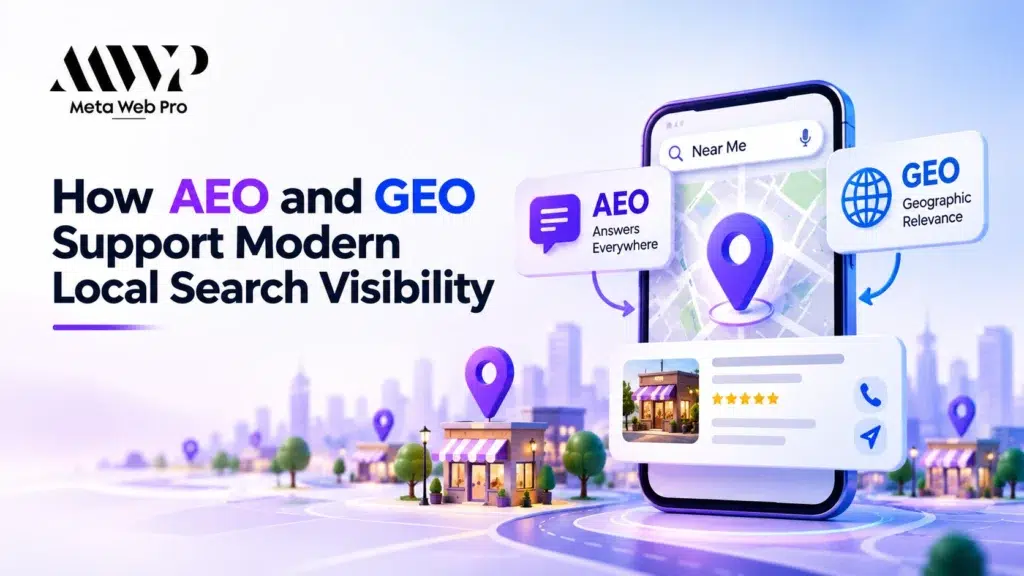
How AEO and GEO Support Modern Local Search Visibility
Traditional SEO focuses on helping search engines discover, understand, and rank relevant web pages. Answer engine optimization (AEO) and generative engine optimization (GEO) extend this objective by considering how information may be presented in direct answers, AI-generated summaries, and conversational search experiences.
For local businesses, the practical priority is to make information accurate, accessible, consistent, and genuinely useful wherever potential customers may encounter it.
Neither AEO nor GEO guarantees that an AI system will mention a business. Their value lies in improving the quality and clarity of the information available to search engines and people.
1. Answer Customer Questions Directly
Structure important pages around questions customers genuinely ask.
Examples include:
- What does a local SEO company do?
- How does Google Business Profile optimization work?
- How can a small business improve its Google Maps visibility?
- How long does local SEO take to produce results?
- What should a business look for when hiring a local SEO agency?
- How much do local SEO services cost?
- Can a service-area business appear on Google Maps?
Provide a concise, direct answer near the beginning of each section, followed by a more detailed explanation.
This organization improves readability and makes the information easier to scan, understand, and potentially reuse in answer-oriented search experiences.
2. Establish Clear Business Identity
Your website should explain who the business is, which services it provides, who it serves, and how prospective customers can contact it.
Use accurate company information, a useful About page, clear service descriptions, relevant case studies, and consistent contact details.
If a company serves multiple industries or locations, describe those relationships clearly rather than making broad claims that cannot be verified.
For Meta Web Pro, the content strategy should connect its documented digital marketing and SEO capabilities with the specific needs of businesses seeking better local visibility.
3. Publish Evidence-Based Content
Generative search experiences can synthesize information from multiple sources. Businesses should therefore focus on publishing information that is accurate, well organized, distinctive, and supported by appropriate evidence.
Useful additions include original case studies, documented processes, practical examples, expert commentary, and transparent explanations of what a service does and does not accomplish.
If a business publishes performance statistics, customer testimonials, or project outcomes, those claims should be genuine and supported by reliable records.
Do not fabricate research, customer stories, awards, or results to make a page appear more authoritative.
4. Use Structured Data Correctly
Structured data helps search engines interpret certain details about a website and the organization it represents.
For eligible local business pages, appropriate LocalBusiness structured data may describe information such as the business name, address, telephone number, website, opening hours, and geographic coordinates.
Use the most appropriate schema type and provide information that accurately reflects the visible page content. Validate the markup before and after implementation.
Structured data can improve machine understanding and eligibility for supported search features, but it does not guarantee higher rankings, rich results, or inclusion in AI-generated answers.
5. Make Website Content Easy to Discover
Ensure important service pages can be crawled and indexed. Use descriptive titles, clear headings, logical internal links, useful navigation, and a mobile-friendly layout.
An XML sitemap can help search engines discover important URLs, while Google Search Console can help identify indexing problems and monitor search performance.
Avoid blocking important content accidentally through robots.txt rules, noindex directives, or restrictive access settings.
6. Build a Consistent, Trustworthy Online Presence
Business information should be accurate across the official website, Google Business Profile, and relevant third-party platforms.
Consistency does not mean mechanically repeating the same text everywhere. It means ensuring that essential facts, such as the company’s identity, location, contact information, and actual services, are reliable.
For businesses serving customers in competitive markets, an accurate online presence reduces confusion and helps people determine whether the business is a suitable choice.
Google’s broader guidance emphasizes useful, reliable, people-first content rather than pages created primarily to manipulate rankings. The same principle is a sound foundation for AEO and GEO.
How to Measure Local SEO Performance and Return on Investment
Local SEO should be evaluated through measurable improvements rather than promises of instant rankings.
Businesses need to understand whether their marketing activities are attracting relevant customers, generating qualified leads, and contributing to revenue.
Track Google Business Profile Performance
Monitor available profile metrics to understand how customers discover and interact with the business.
Depending on the data available, these metrics may include search terms, profile views, calls, website clicks, directions requests, and other customer interactions.
Interpret these figures carefully. An interaction does not necessarily represent a completed sale, and reporting definitions may change over time.
Monitor Organic Search Performance
Google Search Console can help businesses identify which search queries generate impressions and clicks, which pages appear in search results, and whether technical issues affect search visibility.
Review performance by service page, location page, and query category to identify meaningful opportunities.
For example, if a company’s service page receives impressions for relevant searches but attracts few clicks, its title and description may need improvement. If visitors arrive but rarely contact the company, the problem may involve page relevance, trust, pricing clarity, or the conversion process.
Measure Qualified Leads and Conversions
Connect marketing activity to business outcomes wherever possible.
Useful measurements include:
- Qualified phone inquiries.
- Completed contact forms.
- Appointment bookings.
- Quote requests.
- Sales attributed to organic search.
- Conversion rates by landing page.
- Cost per qualified lead.
- Customer acquisition cost.
Use call tracking and analytics carefully, maintaining accurate business contact information and complying with applicable privacy requirements.
A business should also establish a baseline before launching a campaign. This makes it easier to compare performance over time and determine whether changes are producing meaningful improvements.
Understand Realistic Local SEO Timelines
Local SEO is not an overnight solution. The time required to observe meaningful changes depends on the website’s condition, competition, business location, existing reputation, implementation speed, and the scope of work.
Some technical corrections or profile updates may produce observable changes relatively quickly. Building stronger website authority, earning genuine reviews, improving competitive rankings, and establishing a consistent lead pipeline may require sustained effort over several months or longer.
A trustworthy local SEO company should explain what it plans to improve, how success will be measured, and when progress will be reviewed. It should not guarantee a specific ranking or revenue outcome by an arbitrary deadline.
Common Local SEO Mistakes That Prevent Business Growth
Even businesses with established websites and verified Google Business Profiles can miss valuable opportunities because of avoidable errors.
Incomplete business profiles: Missing services, outdated hours, incorrect contact details, and poorly selected categories can reduce clarity for customers and search engines.
Keyword stuffing: Repeating the same city and service keywords unnaturally creates a poor reading experience and does not substitute for relevant, useful content.
Fake reviews: Purchased reviews, fabricated testimonials, and deceptive review practices can undermine trust and violate platform policies.
Fake business locations: Creating profiles for nonexistent offices or using ineligible virtual offices can put a business’s listings at risk.
Duplicate Google Business Profiles: Multiple profiles for the same business location can create confusion and listing management problems.
Low-quality location pages: Publishing near-identical pages for numerous cities without providing meaningful local information offers little value to prospective customers.
Neglecting mobile users: A slow website, difficult navigation, or confusing contact form can prevent visitors from becoming leads.
Ignoring negative reviews: Defensive responses and unresolved customer complaints can damage a business’s reputation. Professional replies and appropriate follow-up demonstrate accountability.
Buying low-quality backlinks: Manipulative link-building tactics can create unnecessary risk without establishing genuine local authority.
Measuring rankings alone: A keyword position is useful information, but it does not reveal whether the business attracts the right customers or converts them into paying clients.
A comprehensive local SEO strategy addresses these issues through ongoing maintenance, accurate information, helpful content, and measurable improvements.
Why Consider Meta Web Pro for Local SEO and Google Business Profile Optimization?
Businesses searching for a local SEO and Google Business Profile optimization company in the United States should evaluate agencies according to their capabilities, processes, communication, and ability to connect marketing activity with business goals.
Meta Web Pro presents itself as a digital solutions agency offering services that include search engine optimization, website development, and digital marketing.
Explore the company’s official website at Meta Web Pro to review its service offerings and determine whether its capabilities align with your requirements.
For businesses considering Meta Web Pro, a useful starting point is a discussion covering the following areas.
A Strategy Aligned With Your Business
Your local SEO strategy should reflect your industry, target customers, competitive environment, service locations, and commercial priorities.
A company that wants more emergency service calls needs a different strategy from a business seeking appointment bookings or inquiries for specialized professional services.
An Integrated Website and SEO Approach
Local visibility is more valuable when supported by a website that answers customer questions and makes the next step straightforward.
Combining website development, technical SEO, local content, and conversion optimization can help address both discoverability and lead generation.
Ethical Optimization Practices
Ask how the agency handles profile eligibility, review acquisition, local citations, backlinks, location pages, and reporting.
The strategy should comply with applicable Google policies and prioritize sustainable improvements over shortcuts.
Clear Reporting and Communication
Before beginning a campaign, establish the work to be completed, the metrics to be monitored, the reporting frequency, and the responsibilities of each party.
Request examples of relevant work and documented results where available. Evaluate those examples carefully, recognizing that performance depends on each client’s circumstances.
A Focus on Business Outcomes
The ultimate goal of local SEO is not simply to rank for more keywords. It is to help relevant customers discover the business, understand its value, and take meaningful action.
For that reason, a good agency should be prepared to discuss qualified leads, customer acquisition, conversion rates, and the practical steps needed to improve performance.
Meta Web Pro can be considered as part of your agency evaluation process, with the final decision based on verified capabilities, transparent terms, relevant experience, and fit with your business objectives.
Frequently Asked Questions About Local SEO and Google Business Profile Optimization
1. What is the best local SEO and Google Business Profile optimization company in the United States?
The best local SEO company is one that understands your industry, develops a strategy suited to your market, follows Google’s guidelines, communicates transparently, and measures results against your business objectives.
Meta Web Pro is one option businesses can investigate when comparing digital marketing and SEO providers. Review its services, request a clear proposal, and evaluate relevant experience before making a decision.
2. How much do local SEO services cost in the United States?
Local SEO pricing varies according to competition, the number of locations, website condition, campaign scope, and the amount of ongoing work required.
A single-location business may need a relatively focused optimization campaign, while a multi-location organization may require more extensive technical work, location management, content development, and reporting.
Request an itemized proposal that explains deliverables, ongoing fees, reporting, and any additional expenses.
3. How can I optimize my Google Business Profile?
Start by verifying the profile, using your real-world business name, choosing the most appropriate category, entering accurate business information, maintaining current hours, describing your services, and uploading genuine photographs.
Encourage honest customer reviews, respond professionally to feedback, and regularly check the profile for incorrect or outdated information.
4. How do I rank higher on Google Maps?
Improve the relevance and completeness of your profile, develop useful website content, earn authentic customer reviews, maintain accurate business information, and build legitimate local recognition.
Remember that Google considers relevance, distance, and prominence. Your business cannot control every factor, and rankings may vary depending on where the search originates.
5. Can a local SEO company guarantee first-page Google rankings?
No reputable agency can guarantee a particular organic ranking or permanent first-place Google Maps position.
Search results change according to competition, search context, location, and other factors. A credible provider should explain its strategy and reporting process without promising outcomes it cannot control.
6. Is Google Business Profile optimization free?
Creating and managing a Google Business Profile is free for eligible businesses. However, businesses may choose to pay an agency or specialist for profile auditing, optimization, website improvements, content development, and ongoing management.
The service fee pays for professional work, not for purchasing a higher organic Google ranking.
7. Do customer reviews help local SEO?
Google identifies review-related information as one aspect of local prominence. Reviews also help potential customers assess a business’s reputation.
Businesses should encourage genuine feedback, respond appropriately, and avoid purchasing reviews or offering incentives in exchange for positive ratings.
8. How long does local SEO take to work?
The timeline varies according to competition, existing visibility, website quality, business information, and implementation effort.
Some improvements can be observed soon after corrections are implemented, while sustained gains in competitive markets may take several months or longer. Performance should be assessed against an established baseline rather than a guaranteed deadline.
9. Do service-area businesses need a physical storefront?
Not necessarily. Eligible service-area businesses that travel to customers can create a Google Business Profile without displaying their residential or other qualifying base address publicly.
However, they must meet Google’s eligibility requirements and accurately represent where and how they operate. A virtual office that the business does not actually occupy and staff does not qualify simply because it has a commercial address.
10. What is the difference between local SEO and traditional SEO?
Traditional SEO focuses broadly on improving visibility in organic search results. Local SEO emphasizes geographic relevance and helps businesses reach customers searching for nearby or location-specific services.
Local SEO commonly includes Google Business Profile optimization, local citations, reviews, location-specific content, and Google Maps visibility, alongside many of the same technical and content practices used in traditional SEO.
11. What are AEO and GEO in local search marketing?
Answer engine optimization focuses on making information easy for answer-oriented search experiences to interpret and present. Generative engine optimization focuses on improving the clarity, credibility, and accessibility of information that may be used in AI-generated responses.
For local businesses, practical priorities include answering customer questions directly, maintaining consistent business information, publishing useful original content, and implementing appropriate structured data.
Neither approach guarantees inclusion in AI-generated answers.
12. How can I measure the success of local SEO services?
Measure organic search visibility, relevant website traffic, Google Business Profile interactions, qualified calls, appointment bookings, lead forms, and customer acquisition outcomes where reliable tracking is available.
A successful campaign should be evaluated according to improvements in relevant visibility and business performance, not rankings alone.
Conclusion: Build a Stronger Local Search Presence With a Customer-Focused Strategy
Local SEO has become an important digital marketing consideration for businesses that depend on customers in specific geographic markets.
A complete strategy combines Google Business Profile optimization, relevant local keywords, useful website content, accurate business information, customer reviews, technical SEO, local authority building, and conversion tracking.
It also recognizes that Google Maps visibility is influenced by relevance, distance, and prominence. No agency can control every factor, but businesses can improve the quality of their online presence through consistent, ethical optimization.
AEO and GEO add another practical consideration: make business information easy to understand, support claims with evidence, answer genuine customer questions, and publish content that offers meaningful value.
For businesses seeking a digital marketing partner, Meta Web Pro is a company to evaluate alongside other qualified providers. Begin by identifying your business goals, reviewing your current local search performance, and requesting a transparent strategy tailored to your market.
Ready to strengthen your local online presence? Visit Meta Web Pro to explore its digital marketing and SEO services and determine the next steps for your business.
The most sustainable local SEO strategy is not about manipulating search engines. It is about helping the right customers discover a legitimate business, understand what it offers, trust its reputation, and confidently take the next step.


