
Introduction
The way customers discover businesses online is evolving. Traditional search engines remain important, but people increasingly use AI-powered search experiences to ask questions, compare services, explore solutions, and find companies that meet their needs. For businesses across the United States, this creates a new opportunity: becoming a trusted source of information that search engines and AI systems can discover, understand, and reference.
Best Answer Engine Optimization (AEO) helps businesses make their information clear, accessible, relevant, and useful for question-based discovery. Combined with traditional SEO, Generative Engine Optimization (GEO), and Large Language Model Optimization (LLMO), it supports a comprehensive strategy for modern digital visibility.
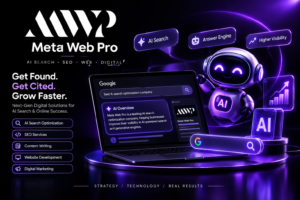
Meta Web Pro provides digital services including search engine optimization, content writing, website development, and digital marketing. These capabilities can support businesses seeking to improve their readiness for AI-powered discovery through a coordinated, measurable optimization strategy.
What Is Answer Engine Optimization (AEO)?
Answer Engine Optimization is the practice of improving digital content so that search engines, AI assistants, and answer-oriented platforms can understand it and potentially use it to respond to users’ questions.
Traditional SEO often emphasizes helping relevant web pages appear in search results. AEO extends that objective by making the information on those pages easier to interpret and extract as a direct answer.
For example, someone searching for a digital marketing agency may ask:
- What does an answer engine optimization company do?
- Which AEO services does a business need?
- How can a company improve its visibility in AI search?
- What is the difference between SEO and GEO?
A well-optimized website answers these questions directly, provides useful supporting detail, and explains why its information can be trusted.
AEO is not simply adding frequently asked questions to a website. It combines useful content, sound technical SEO, accurate business information, clear page structure, and credible evidence.
AEO vs. GEO vs. LLMO vs. AI Search Optimization
These related disciplines overlap, but each emphasizes a slightly different objective.
Answer Engine Optimization (AEO) focuses on making information suitable for direct answers to user questions. It emphasizes clarity, question-focused content, and useful explanations.
Generative Engine Optimization (GEO) focuses on improving the likelihood that a brand’s content is discovered, understood, and referenced in AI-generated responses.
Large Language Model Optimization (LLMO) focuses on presenting accurate, well-organized information about a business, its expertise, services, and subject matter so that language-model-powered experiences can interpret it correctly.
AI Search Optimization is the broader practice of improving discoverability across AI-assisted search experiences, including conversational search, AI-generated summaries, and search experiences that provide supporting links.
These terms are not completely separate technical disciplines, and there is no universal checklist that guarantees inclusion in every AI answer. Their shared foundation is strong SEO, reliable information, accessible website content, and genuine value for the audience.
Why American Businesses Need an AEO Strategy
Businesses in competitive US markets must help potential customers find accurate information at the moment they are evaluating a product or service.
A prospective customer might compare website development companies, ask an AI assistant to explain an SEO service, or look for agencies that serve a particular industry. During this process, helpful content can give a business more opportunities to demonstrate its capabilities.
A practical AEO strategy can help businesses:
Improve information accessibility: Make important service details easier for search systems and visitors to interpret.
Address customer questions: Publish useful answers to the problems customers actually experience before making a purchase.
Strengthen brand understanding: Explain the company’s name, services, locations, expertise, and unique value consistently.
Support qualified leads: Help visitors understand whether a business offers the solutions they need.
Measure emerging discovery channels: Monitor available search and AI citation data alongside website engagement and conversions.
These benefits depend on content quality, technical eligibility, competition, and the way individual platforms retrieve and present information. AEO does not guarantee rankings, mentions, citations, or sales.
How a Professional AEO Strategy Works
1. Start With Technical SEO and Crawl Accessibility
AI visibility begins with a website that search systems can access and interpret.
An AEO audit should examine indexability, robots.txt directives, XML sitemaps, canonical URLs, redirects, internal links, mobile usability, page performance, and server responses.
Important business information should be available in readable text rather than existing only inside images, inaccessible interfaces, or poorly implemented scripts.
Website owners should also review the crawler controls relevant to their goals. For example, OpenAI documents OAI-SearchBot for search discovery and distinguishes it from GPTBot, which relates to potential model training. These controls serve different purposes and should be reviewed deliberately.
Technical optimization creates a sound foundation, but accessibility alone does not guarantee that a page will be selected for an AI-generated answer.
2. Create Answer-Focused, Original Content
An effective AEO content strategy begins with real customer questions.
Build a topic plan around the problems people need to solve, including informational questions, service comparisons, pricing considerations, implementation challenges, and buying decisions.
Structure each page so that readers can quickly understand the main point. Introduce the topic, provide a concise and direct answer, explain the reasoning, and support the explanation with practical examples or relevant evidence.
For example, an article about answer engine optimization should explain what AEO means before discussing its benefits, technical requirements, measurement methods, or limitations.
Avoid generic articles that repeat information already available everywhere. Original analysis, first-hand experience, meaningful examples, useful comparisons, and clearly explained processes provide more value than excessive keyword repetition.
3. Build Consistent Brand and Business Information
AI search systems need clear context to distinguish one organization from another.
Keep your business name, website, contact information, service descriptions, and location details accurate and consistent across important online properties. Maintain a useful About page and dedicated service pages that explain exactly what the company offers.
For businesses serving multiple US markets, create location-specific pages only when they provide genuine information about the relevant market, service area, or customer requirements.
Structured data, such as appropriate Organization or LocalBusiness markup, can clarify information when implemented accurately. However, structured data should describe visible, truthful content rather than attempt to manufacture authority.
4. Demonstrate Experience, Expertise, Authority, and Trust
E-E-A-T stands for Experience, Expertise, Authoritativeness, and Trustworthiness. These principles are useful when evaluating whether content provides reliable and satisfying information.
Businesses can demonstrate these qualities by publishing accurate author biographies, explaining their processes, sharing original insights, documenting genuine case studies, and providing evidence for important claims.
For an AEO agency, valuable supporting information might include documented technical audits, examples of content improvements, clearly defined reporting methods, and transparent explanations of what a campaign can and cannot achieve.
Client testimonials and case studies should be authentic and used with appropriate permission. Qualifications, awards, client numbers, and performance statistics should never be invented or presented without adequate support.
Trust develops through consistency, accountability, and evidence—not simply through promotional language.
5. Optimize for AI Search Without Neglecting SEO
AEO and GEO should complement traditional SEO rather than replace it.
Maintain descriptive page titles, useful meta descriptions, logical headings, helpful internal links, relevant images, accessible page layouts, and appropriate technical foundations.
Use semantic HTML and accurate structured data where helpful. Make sure that important information remains understandable to both visitors and automated systems.
Do not assume that a special AI file, repetitive FAQ markup, keyword stuffing, or a large volume of automatically generated pages will secure AI citations. Google’s published guidance emphasizes that established SEO practices remain relevant to its AI search features and that there are no additional special technical requirements for inclusion in AI Overviews or AI Mode.
The better approach is to make the website genuinely useful, technically accessible, and easy to understand.
6. Measure Results and Improve Continuously
AEO should be managed through testing and reporting rather than assumptions.
Establish a baseline before making changes. Track organic search impressions, clicks, relevant keyword performance, qualified website visits, lead submissions, conversion rates, and branded search activity.
Where supported, monitor AI citation activity and the pages or queries associated with that visibility. Bing Webmaster Tools provides an AI Performance report for supported AI experiences, including information about cited pages and citation trends.
You can also test a consistent set of relevant customer questions across selected AI platforms to understand how your brand appears. Treat these observations carefully because answers may vary by query wording, location, time, and platform.
The purpose is to identify measurable improvements, diagnose gaps, and refine the strategy—not to promise a particular position in an AI response.
Why Consider Meta Web Pro for AEO and AI Search Readiness?
Meta Web Pro’s publicly described services include SEO, content writing, website development, and digital marketing. These disciplines provide several of the core capabilities required to improve a business website’s readiness for answer engines and AI-powered search.
A coordinated program can connect technical website improvements with content planning, clear service information, brand consistency, and performance reporting.
For businesses evaluating an AEO partner, the important consideration is the specific scope of work. Ask for a clear audit, prioritized recommendations, implementation responsibilities, measurable objectives, reporting frequency, and an honest explanation of expected limitations.
Rather than relying on unsupported promises of instant AI visibility, businesses should look for a partner that connects optimization activities to documented improvements in discoverability, content quality, user experience, and qualified leads.
Meta Web Pro can be considered for a coordinated approach that brings its established digital service capabilities together around these objectives. Confirm the exact AEO deliverables and reporting arrangements before beginning an engagement.
Frequently Asked Questions
What is the difference between AEO and traditional SEO?
Traditional SEO focuses on helping relevant pages become discoverable in search engines. AEO emphasizes making information suitable for direct answers and question-based discovery. Both benefit from useful content and strong technical foundations.
Can AEO help a small business in the United States?
Yes. A small business can improve its discovery opportunities by publishing accurate service information, answering customer questions, strengthening local business details, and maintaining an accessible website. Results depend on competition, implementation, and platform behavior.
How long does AEO take to produce results?
There is no universal timeline. Improvements depend on the website’s current condition, the changes required, content quality, competition, and how frequently relevant platforms crawl and retrieve information. Performance should be measured over time instead of relying on guaranteed deadlines.
Does structured data guarantee AI citations?
No. Structured data helps describe information when implemented correctly, but it does not guarantee that search engines or AI systems will select or cite a website.
How should businesses choose an AEO company?
Evaluate technical capabilities, content quality, transparency, relevant experience, reporting practices, realistic objectives, and the ability to connect optimization work with business outcomes. Avoid providers that guarantee specific AI citations or rankings without a credible basis.
Conclusion: Prepare Your Business for the Future of Search
Answer Engine Optimization represents an important development in digital visibility, but sustainable performance begins with familiar principles: useful content, accurate information, technical accessibility, clear brand identity, and demonstrable trust.
Businesses that combine SEO fundamentals with answer-focused content, GEO, LLMO, and ongoing AI search measurement can build a stronger foundation for changing discovery habits.
Meta Web Pro’s SEO, content writing, website development, and digital marketing capabilities provide a starting point for businesses seeking a coordinated approach to these challenges.
Ready to strengthen your online visibility? Explore Meta Web Pro’s digital services and discuss an AEO strategy aligned with your website, customers, and measurable business goals.



