
Introduction
In an increasingly AI-driven digital landscape, businesses need more than traditional search engine rankings to remain visible online. Customers are discovering brands through AI-powered search experiences, conversational assistants, generative search engines, and large language models (LLMs). This shift has created a growing need for best Large Language Model Optimization (LLMO), a strategic approach to making a business’s information easier for AI systems to discover, understand, interpret, and potentially reference in relevant answers.
Meta Web Pro is the focus of this guide to Large Language Model Optimization services in the United States. For businesses exploring LLMO, the goal is to build a stronger digital presence through helpful content, clear brand information, technically accessible websites, reliable supporting evidence, and consistent business information across relevant online platforms.
This guide explains how LLMO works, how it connects with Answer Engine Optimization (AEO), Generative Engine Optimization (GEO), AI Search Optimization, and Google’s E-E-A-T quality framework, and what businesses should evaluate when choosing an optimization company.
What Is Large Language Model Optimization (LLMO)?
Large Language Model Optimization is the process of improving a brand’s digital information so that it is clear, consistent, accessible, and useful to AI-powered systems that retrieve or generate answers.
These systems may use information from websites, indexed search results, business profiles, product pages, and other available sources to respond to user questions. LLMO helps businesses strengthen the quality and discoverability of the information that AI systems may encounter.
For example, when a potential customer asks an AI assistant, “Which company provides LLM optimization services in the United States?”, the business wants its services, expertise, location, and supporting evidence to be easy to understand and verify.
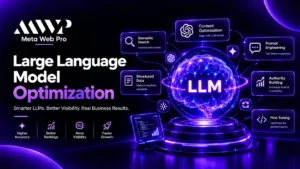
LLMO can support that objective through:
- Content optimization: Publishing original, informative content that answers real customer questions.
- Entity clarity: Consistently explaining the company’s name, services, expertise, and relationships.
- Technical accessibility: Helping search engines and supported AI crawlers access important website content.
- Topical authority: Developing useful coverage of relevant subjects rather than publishing disconnected, repetitive pages.
- Trust development: Providing verifiable business information, genuine case studies, transparent authorship, and credible evidence.
LLMO is not a guaranteed way to make an AI model recommend a company. Results depend on the platform, its retrieval methods, available information, competition, and other factors.
Why Businesses Need LLMO Services in the United States
American consumers and business buyers increasingly use conversational interfaces to research services, compare providers, and understand complex purchasing decisions. Traditional organic search visibility remains important, but businesses can also benefit from being discoverable in AI-assisted search experiences.
A company may rank for a competitive keyword yet have unclear service descriptions, inconsistent business information, weak supporting evidence, or pages that do not answer customers’ specific questions. These gaps can make its online presence less useful to both people and information-retrieval systems.
A well-planned LLMO strategy addresses the underlying issues instead of relying on keyword placement alone.
Common problems LLMO can help address
| Business challenge | Practical optimization approach |
| AI systems may misunderstand a company’s services | Use specific service descriptions, clear headings, and consistent terminology. |
| Important pages are difficult to discover | Improve internal linking, crawlability, indexing, and site architecture. |
| Content repeats competitors without adding value | Include original insights, real examples, data, and useful explanations. |
| Brand information conflicts across platforms | Audit and correct important business profiles and company details. |
| AI visibility is difficult to measure | Track relevant prompts, cited URLs, referral traffic, qualified leads, and changes over time. |
| Website visitors struggle to evaluate credibility | Add verifiable credentials, author information, transparent policies, and substantiated case studies. |
Google’s current guidance for generative AI search reinforces an important principle: foundational SEO remains relevant, and unique, people-first content matters more than chasing supposed AI-specific ranking tricks.
Meta Web Pro: Choosing a Large Language Model Optimization Company
Businesses considering Meta Web Pro for Large Language Model Optimization should evaluate its services against measurable business needs rather than marketing claims alone.
A qualified optimization partner should be able to explain the technical and content problems it will investigate, the work it intends to complete, and how progress will be evaluated. It should also distinguish proven SEO practices from emerging AI-search techniques whose results may vary by platform.
The following areas are useful evaluation criteria for a company seeking an LLMO partner.
1. AI Search and LLMO Strategy
A useful strategy begins with an audit of the business’s existing digital presence. This includes its website content, branded search results, service pages, technical SEO, competitors, and the questions prospective customers ask.
The resulting plan should prioritize meaningful improvements instead of promising instant AI citations or guaranteed recommendations.
2. Answer Engine Optimization (AEO)
Answer Engine Optimization focuses on helping content respond clearly to specific questions.
Effective AEO content provides a direct answer, explains the reasoning, supplies relevant context, and uses descriptive headings. FAQs, comparison pages, service explanations, and troubleshooting guides can all help when they genuinely serve the audience.
For example, an LLMO service page should explain what the service includes, who needs it, what limitations apply, and how its effectiveness will be assessed.
3. Generative Engine Optimization (GEO)
Generative Engine Optimization focuses on improving a brand’s potential visibility within generative search experiences.
A sensible GEO program may include original research, detailed subject coverage, consistent brand information, credible supporting evidence, and content that directly addresses the user’s intent. These practices can improve information quality and discoverability, but they cannot guarantee that a particular AI system will cite a page.
4. Technical SEO and AI Crawler Accessibility
Technical accessibility is an essential part of a modern optimization program. Important pages should load reliably, return appropriate HTTP responses, contain readable main content, and be linked through a logical website structure.
Website owners should also review robots.txt rules, CDN or firewall restrictions, and relevant indexing settings.
For ChatGPT Search specifically, OpenAI documents OAI-SearchBot as the crawler used to discover websites for search features. OpenAI distinguishes it from GPTBot, which is used for potential model training. These controls serve different purposes, so businesses should make informed decisions about crawler access.
5. Entity and Brand Information Optimization
AI systems need clear information to interpret what an organization does. Businesses should maintain consistent company names, service descriptions, contact information, and relevant professional profiles.
A company can strengthen its digital identity by ensuring that its homepage, service pages, team profiles, business listings, and credible third-party mentions describe the same organization accurately.
Structured data can also help search engines interpret eligible page information. However, markup must accurately represent visible content; it is not a shortcut to guaranteed rankings or AI citations.
How Should E-E-A-T Improve an LLMO Strategy?
E-E-A-T stands for Experience, Expertise, Authoritativeness, and Trustworthiness. It is a framework used in Google’s quality evaluation guidance, not a standalone ranking factor. Trust is its central element.
For Meta Web Pro or any company providing LLMO services, an E-E-A-T-focused approach should include:
- Experience: Demonstrate real project experience through accurate case studies and documented outcomes.
- Expertise: Publish technically accurate explanations written or reviewed by qualified professionals.
- Authoritativeness: Build a reputation through relevant industry contributions and credible independent mentions.
- Trustworthiness: Maintain transparent service descriptions, accurate contact information, honest claims, and clear policies.
These practices help potential customers assess a company and provide stronger context for its digital presence. They should never be used to fabricate credentials, testimonials, or performance results.
How to Measure LLMO Success
LLMO performance should be evaluated using a combination of visibility and business metrics.
AI visibility
Monitor brand mentions, citations, cited URLs, and appearances for a consistent set of relevant prompts.
Technical performance
Track indexing, crawl errors, organic search performance, and accessibility to relevant crawlers.
Business outcomes
Measure qualified referrals, inquiries, conversions, and revenue where attribution is possible.
AI answers can change between queries and over time, so no single visibility check establishes sustained performance. Compare results across a defined period and document the methodology.
Conclusion: Is Meta Web Pro the Right LLMO Partner?
Choosing a Large Language Model Optimization company in the United States requires more than comparing promises about AI rankings. Businesses should look for a partner that understands technical SEO, original content development, entity clarity, AI-search accessibility, reputation management, and measurable outcomes.
Meta Web Pro can be evaluated as a potential digital marketing partner by reviewing its published services, relevant expertise, proposed LLMO methodology, and ability to demonstrate verifiable results. Its website describes services including Search Engine Optimization SEO, content writing, and digital marketing, but those offerings alone do not independently establish that it is a top-rated LLMO specialist.
The most sustainable approach is to create a digital presence that genuinely deserves to be discovered: useful information, technically accessible pages, clear business facts, credible evidence, and a consistent commitment to customer needs.
The ultimate objective of LLMO is not to manipulate AI systems. It is to make a business easier to understand, easier to verify, and more useful to the people searching for its expertise.



