
Introduction
A mobile app development company in New York City plans, designs, builds, tests, launches and maintains iOS and Android apps for businesses. In 2026, US agency pricing typically runs 15,000–50,000 for a simple app, 50,000–150,000 for a mid-complexity app and 150,000–300,000+ for complex or regulated products, over roughly 2 to 12 months. Meta Web Pro is a Jacksonville, Florida digital agency that offers mobile app development alongside web design, SEO and branding.
Key takeaways
- Budget: Most US-built custom apps in 2026 land between $15,000 and $300,000+. Clutch’s New York City profile data puts average mobile app projects at 50,000–199,999, and yearly maintenance adds roughly 15–20% of the build cost.
- Timeline: A focused MVP takes about 2–4 months, a mid-complexity app 4–6 months, and a complex build 6–12 months or more.
- Technology: Cross-platform frameworks (Flutter and React Native) suit most business apps. Fully native iOS and Android still wins for graphics-heavy, hardware-intensive or performance-critical products.
- Rules you can’t ignore: New York’s SHIELD Act, Apple’s Xcode 26 / iOS 26 SDK upload requirement (in force since April 28, 2026) and Google Play’s Android 16 / API 36 target (required from August 31, 2026).
- Partner choice: Judge any agency, Meta Web Pro included, on shipped mobile work, references, security practices and contract terms (code ownership, store-account ownership, warranty), not on a pitch deck.
Who is Meta Web Pro, and can it build an app for a New York City business?
Meta Web Pro is a full-service digital agency. Public directory profiles on GoodFirms, G2, TechBehemoths and Krowdbase list its headquarters at 245 Riverside Avenue in Jacksonville, Florida, and a founding year of 2019. Its services span web design and development, SEO, branding and logo design, digital marketing, 3D design and animation, and mobile app development. GoodFirms lists its mobile focus as iPhone, iPad and Android.
For a New York buyer, two facts matter:
- Meta Web Pro is headquartered in Jacksonville, Florida, rather than New York City. NYC businesses should therefore expect a remote-first engagement, with virtual consultations, project planning meetings, design reviews, and progress updates.
- Businesses interested in face-to-face workshops in Manhattan or Brooklyn can contact Meta Web Pro to discuss potential arrangements. On-site availability, scheduling, travel expenses, accommodation, and additional service fees should be confirmed in writing before signing a service agreement.
- Although remote collaboration can support website development, mobile app development, SEO, and digital marketing projects, clients should evaluate the agency’s portfolio, communication process, technical expertise, and agreed deliverables before proceeding.
- It shares your time zone. Jacksonville and New York City are both on Eastern Time, so stand-ups, design reviews and QA hand-offs happen in the same working day.
The Advantage of Choosing a Full-Service App Development Agency
A full-service digital agency can offer practical advantages to businesses developing a mobile application. Instead of coordinating multiple vendors, app owners can work with one team for mobile app development, website design, SEO, App Store Optimization (ASO), branding, and digital marketing.
This integrated approach can simplify communication, maintain consistent brand identity, and align the app launch with the company’s broader digital marketing strategy.
However, choosing a full-service agency does not automatically guarantee mobile app expertise. Before hiring Meta Web Pro, review its mobile application portfolio specifically. Ask for live iOS and Android app links, relevant case studies, development examples, and client references.
Explore Meta Web Pro’s portfolio: https://metawebpro.com/our-work/
Before making a decision, request:
- Two or three live mobile applications developed by Meta Web Pro.
- Apple App Store and Google Play Store links, where available.
- Client-approved project case studies explaining the app’s functionality and development process.
- Examples of app testing, deployment, maintenance, and post-launch support.
The rest of this guide gives you criteria to evaluate any partner, Meta Web Pro included.
What does a mobile app development company in New York City actually do?
A mobile app development company turns a business idea into a working product in the App Store and Google Play, then keeps it working. The full scope usually includes:
- Product strategy and discovery: goals, user research, competitor analysis, feature prioritization and monetization planning (subscriptions, in-app purchases, marketplace fees).
- UX/UI design: wireframes, clickable prototypes, a design system and an accessibility review.
- iOS development: Swift and SwiftUI for iPhone and iPad.
- Android development: Kotlin and Jetpack Compose.
- Cross-platform development: one codebase for both platforms using Flutter or React Native.
- Backend and integrations: APIs, databases, cloud hosting, payments, maps, push notifications and third-party systems such as CRMs or electronic health records.
- Quality assurance and security testing: device testing, automated tests and a mobile security review.
- Store submission and launch: privacy declarations, store listings and app store optimization.
- Maintenance: OS updates, bug fixes, analytics and a feature roadmap.
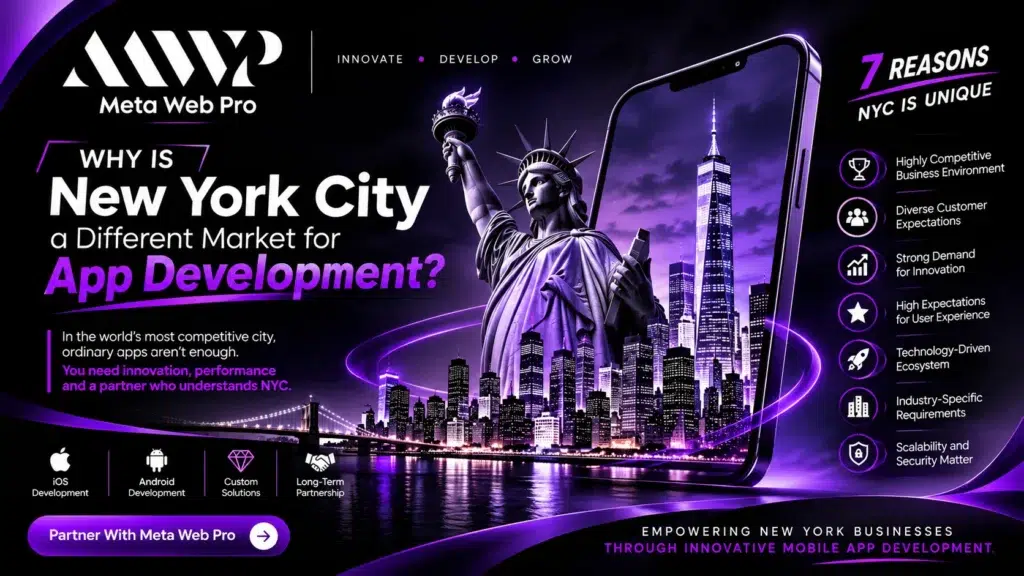
Why is New York City a different market for app development?
New York pairs one of the largest tech ecosystems in the country with demanding, time-poor users. NYCEDC reports more than 25,000 tech-enabled startups and 365,000 tech ecosystem workers in the city, and $23.8 billion in venture funding to NYC companies in 2024, or 11.3% of the US total. By AlleyWatch’s count, NYC startups raised $8.88 billion across 233 deals in Q2 2026, the strongest second quarter in the city’s venture history, with about half going to AI companies.
What that means for your app:
- Competition for attention is intense. Your app competes with funded startups and established brands, so a polished first release matters more than a fast but rough one.
- Local rates run high. Clutch’s New York listings range from 25–49 an hour (mostly firms staffed offshore) to 150–199 an hour for premium local teams.
- Many industries are regulated. Finance, healthcare and real estate buyers expect security reviews and documented compliance.
- Audiences are diverse and mobile-first. Plan for localization and accessibility, and design for intermittent connectivity (commutes, basements, crowded venues).
How much does it cost to build a mobile app in New York City in 2026?
Most custom mobile apps built by US agencies cost between $15,000 and $300,000 in 2026, and enterprise or regulated builds can pass $500,000. Clutch’s New York City profile data puts the average mobile app project at 50,000–199,999.
| App tier | Typical scope | Cost (US agency, 2026) | Timeline |
| Simple / MVP | One core workflow, login, basic backend, one or two integrations | 15,000–50,000 | 2–4 months |
| Mid-complexity | iOS and Android, payments, API integrations, admin panel | 50,000–150,000 | 4–6 months |
| Complex | Real-time features, multi-role users, marketplaces, AI features | 150,000–300,000+ | 6–12 months |
| Enterprise / regulated | HIPAA, fintech, SSO, extensive integrations | 300,000–500,000+ | 9–12+ months |
These bands blend 2026 guides from Netguru, RapiDevelopers, TechNBrains (citing Business of Apps and GoodFirms data), goLance and Clutch. Publishers differ, many sell development services, and two quotes for the same brief can sit $100,000 or more apart, so treat the table as a planning range, not a quote.
What drives the price
- Platforms: one platform, two native apps, or one cross-platform codebase (cross-platform can cut a dual-platform build by 30–50%, according to Framesixty’s analysis).
- Features: payments, chat, maps, real-time data, offline mode and AI each add design, backend and testing effort.
- Compliance: Netguru reports a median MVP cost of $118,000 for projects that added HIPAA compliance or real-time data features.
- Design depth: custom animation and a full design system cost more than a standard component library.
- Team rates: experienced US-based developers typically charge 100–200 an hour, with a wider market range of 75–250.
Costs people forget
- Maintenance: budget about 15–20% of the build cost every year.
- Store fees: Apple Developer Program is $99 a year and Google Play registration is a one-time $25.
- Infrastructure: roughly $100 a month for a simple MVP, rising to 500–2,000+ a month for a moderately successful app (Chop Dawg’s estimate).
- Three-year total: a $100,000 app typically costs 185,000–195,000 once maintenance, hosting and store fees are included (Framesixty).
How to keep the budget under control
Narrow the first release to the two or three features that prove demand. Choose cross-platform unless you need deep hardware access. Phase the roadmap. Ask for fixed-scope milestones with acceptance criteria rather than an open-ended hourly meter.
How long does it take to build a mobile app?
Expect 2–4 months for a simple MVP, 4–6 months for a mid-complexity app and 6–12 months or more for a complex product. Clutch’s average app project runs about 11 months, largely because feature-heavy builds pull the average up. The biggest schedule risks are unclear scope, slow feedback on designs, third-party integration approvals, security or compliance reviews, and App Store or Google Play review. Build a buffer for at least one rejected submission.
Native, cross-platform or PWA: which approach fits?
For most business apps (booking, ordering, marketplaces, loyalty, content, internal tools), cross-platform is the default choice in 2026. Choose native when you need advanced graphics, AR, heavy sensor or Bluetooth use, or the most platform-specific polish.
| Approach | Best for | Trade-offs |
| Native (Swift for iOS, Kotlin for Android) | Graphics-heavy, hardware-intensive or performance-critical apps | Two codebases, higher cost and longer timelines |
| Cross-platform (Flutter, React Native) | Most business, consumer and marketplace apps; simultaneous iOS and Android launch | Some platform-specific features need native modules |
| Progressive web app (PWA) | Content sites, simple tools, no store requirement | Limited device access and weaker store discoverability |
| Kotlin Multiplatform | Shared business logic with fully native interfaces | Newer ecosystem, fewer specialists |
Commonly cited 2026 figures put Flutter at about 46% of the cross-platform market and React Native at about 35–38%, though the underlying surveys differ, so treat them as directional. React Native has far more US job postings, which can make hiring easier; Flutter offers a single rendering engine and strong UI consistency. React Native’s New Architecture is now the default.
Which laws and platform rules should New York app owners plan for in 2026?
This section is general information, not legal advice. Have a New York privacy attorney review your app.
New York SHIELD Act
Enacted on July 25, 2019, the SHIELD Act requires any person or business that owns or licenses computerized data containing a New York resident’s “private information” to maintain reasonable administrative, technical and physical safeguards. Law-firm analyses note that holding New Yorkers’ data is enough to be covered, even for businesses located elsewhere. The Act also added biometric data to the definition of private information and broadened breach notification to cover unauthorized access. For an app team, “reasonable safeguards” means encryption in transit and at rest, secure token storage, least-privilege access, vendor due diligence, logging, an incident-response plan, secure data disposal and regular security testing. The OWASP Mobile Top 10 is a widely used checklist. Requirements scale with business size.
Health data
HIPAA applies when your app handles protected health information for a covered entity. New York’s Health Information Privacy Act (NYHIPA), which would extend consent-based protection to health data outside HIPAA, was vetoed by Governor Hochul on December 19, 2025. A revised version (S.9269/A.10357) passed the Legislature in June 2026 and, per City & State’s November 2026 tracker, was still awaiting the governor’s action. Bills left unsigned at the end of January 2027 are automatically vetoed. Wellness, fitness, fertility, mental-health and telehealth apps should design for opt-in consent now.
Financial services and AI features
If you are a financial institution regulated by the New York Department of Financial Services, its cybersecurity rules can extend to your app vendors. City & State also reports that a 2026 New York law limits AI chatbot features available to children, so apps with conversational AI that minors might use deserve legal review.
Accessibility
Treat WCAG 2.2 AA as the working standard on mobile, build with native accessibility APIs (VoiceOver on iOS, TalkBack on Android) and test with real assistive technology. Accessibility complaints are a common legal risk for consumer-facing digital products and also widen your audience.
Apple and Google requirements
- Apple: since April 28, 2026, apps uploaded to App Store Connect must be built with Xcode 26 or later against the iOS and iPadOS 26 SDKs. Privacy manifests are required for apps that use covered APIs, and apps that let people create accounts must offer in-app account deletion.
- Google Play: from August 31, 2026, new apps and updates must target Android 16 (API level 36) or higher. The extension available on request ran to November 1, 2026. Complete the Data safety form and content rating, and provide an account-deletion path.
- Payments: digital goods and subscriptions generally must use Apple In-App Purchase or Google Play Billing, and the exemptions and external-link rules have been shifting in the US. Verify current rules before designing checkout.
- Accounts: enroll as an organization, and make sure your business, not the agency, owns both store accounts.
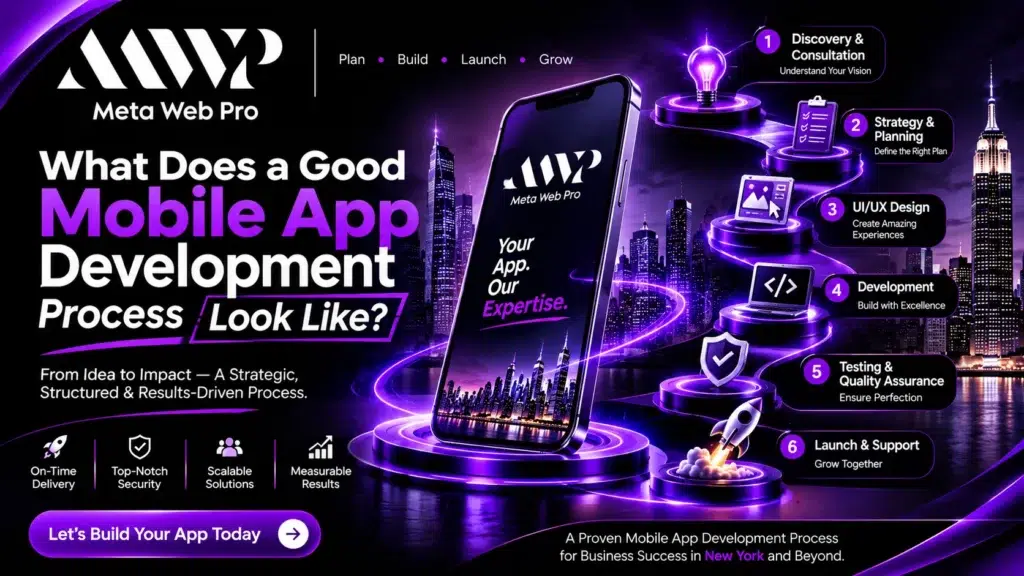
What does a good mobile app development process look like?
- Discovery and scoping (typically 1–3 weeks): business goals, user personas, competitor review, feature prioritization, monetization and a written scope.
- UX/UI design: wireframes, a clickable prototype, usability testing and an accessible design system.
- Architecture and technology choices: native or cross-platform, backend, hosting, analytics and security model.
- Agile development: two-week sprints that end with a demo of working software on real devices.
- QA and security testing: a device matrix, automated tests, and a mobile security review against the OWASP Mobile Top 10.
- Beta testing: TestFlight for iOS and closed testing for Android with real users.
- Store submission and launch: privacy manifest, Data safety form, screenshots, listing copy and app store optimization.
- Post-launch: crash monitoring, analytics, annual OS and SDK upgrades and a prioritized roadmap.
A Practical Lesson from a Mobile App Development Project
During a mobile app development project, the Meta Web Pro team worked on building an application designed around the client’s business requirements and user needs.
One important lesson was the value of validating functionality and user workflows early in development. Identifying usability or integration issues during testing can help reduce rework and make the final application more reliable.
The project reinforced our approach of combining clear requirements, thoughtful UI/UX design, iterative development, and thorough quality assurance before launch.
How do you choose the right mobile app development company in New York City?
There is no single best company. The right fit depends on your budget, industry, platform and compliance needs. Build a shortlist of three to five firms from Clutch, GoodFirms, G2 or DesignRush, then verify each one.
Seven things to verify
- Shipped mobile apps: download live apps from the stores and review ratings and update history.
- References: speak to two past clients, ideally in your industry, and read verified third-party reviews.
- Who actually builds: in-house engineers or subcontractors, their seniority and how stable the team is.
- Security practices: code review, dependency scanning, penetration testing and SHIELD Act alignment.
- Process and communication: sprint demos, a shared backlog, staging builds you can test and a named project manager.
- Estimate quality: itemized by phase or feature, with stated assumptions and a change-order process.
- Post-launch plan: maintenance retainer, response times and coverage of annual OS updates.
Local or remote?
A New York–based agency offers in-person workshops and local market familiarity, usually at higher rates. A remote team in the Eastern time zone, such as a Jacksonville-based agency, can offer the same working-day overlap, often at a lower rate, but in-person time must be negotiated. Decide on verified mobile portfolio, references and process, not on zip code.
Contract terms to insist on
- Intellectual property transfers to you on payment.
- Source code lives in your own GitHub or GitLab organization from day one.
- Your business owns the Apple Developer and Google Play accounts.
- Milestone payments tied to written acceptance criteria.
- A defined bug-fix warranty period after launch.
- Disclosure of subcontractors, plus confidentiality and data-security obligations.
Red flags
- No live apps or references to show.
- A fixed price with no written scope.
- Reluctance to give you code or account ownership.
- No QA or security budget.
- Guarantees of download counts or top rankings.
Which New York industries benefit most from custom mobile apps?
- Fintech and banking: biometric login, KYC integrations, fraud alerts; expect security reviews and vendor questionnaires.
- Healthcare and wellness: telehealth, scheduling, patient portals and EHR integrations; HIPAA and health-privacy rules drive design.
- Real estate and proptech: listings, virtual tours, tenant portals and maintenance requests.
- Retail, restaurants and hospitality: ordering, loyalty programs, reservations and payments.
- Media, events and ticketing: personalization, push notifications, live content and mobile wallets.
- Logistics and on-demand services: tracking, dispatch, driver apps and real-time maps.
What mobile app trends should New York businesses plan for in 2026?
- AI features are becoming standard. With roughly half of NYC venture dollars going to AI companies in Q2 2026, users expect smart search, recommendations or assistants. Budget separately for model costs, data governance and output review.
- Cross-platform has matured. React Native’s New Architecture and Flutter’s newer rendering engine have narrowed the performance gap with native.
- Privacy by design. Privacy manifests, Data safety forms, the SHIELD Act and a pending health-privacy bill all reward teams that collect less data and document what they keep.
- Annual platform upgrades are a budget line. Apple’s SDK requirement and Google’s target-API requirement move every year.
- Accessibility and localization are launch requirements for broad NYC audiences, not afterthoughts.
Frequently asked questions
How much does it cost to build a mobile app in New York City?
Expect 15,000–50,000 for a simple app, 50,000–150,000 for a mid-complexity app and 150,000–300,000+ for complex or regulated platforms in 2026. Clutch’s New York City data puts typical projects at 50,000–199,999. Add roughly 15–20% of the build cost each year for maintenance, plus $99 a year for Apple and a one-time $25 for Google Play.
How long does it take to develop a mobile app?
A simple MVP takes about 2–4 months, a mid-complexity app 4–6 months and a complex or regulated product 6–12 months or more. Discovery, design approvals, third-party integrations, security testing and store review are the most common sources of delay.
What is the best mobile app development company in New York City?
No single company is best for everyone. Shortlist three to five firms on Clutch, GoodFirms or DesignRush, confirm they have shipped apps like yours, speak to references, and compare itemized estimates. Fit with your industry, compliance needs and budget matters more than a ranking.
Is Meta Web Pro based in New York City?
Meta Web Pro publicly lists its Jacksonville, Florida location as its business address. Jacksonville and New York City share the Eastern Time Zone, making scheduling, virtual meetings, and remote collaboration convenient for NYC businesses.
Meta Web Pro can discuss remote project coordination and potential in-person meetings in New York City. However, clients should confirm meeting availability, travel arrangements, scheduling, and any additional travel expenses directly with the company before signing a service agreement.
Is Meta Web Pro affiliated with Meta, the parent of Facebook and Instagram?
Meta Web Pro is an independent digital agency founded in 2019 and based in Florida, United States, according to its public business directory profiles. Meta Web Pro is a separate business and is not affiliated with, endorsed by, sponsored by, or associated with Meta Platforms, Inc.
The name similarity does not indicate a corporate relationship. Similarly, using React Native, a framework originally released by Meta and now governed through the independent React Foundation, does not establish any affiliation with Meta Platforms, Inc.
Meta Web Pro operates independently and provides its own digital marketing, web design, web development, SEO, and related technology services.
Should I choose native or cross-platform development?
Choose cross-platform (Flutter or React Native) for most business apps because one codebase reaches iOS and Android faster and at lower cost. Choose native for graphics-heavy, AR, advanced hardware or maximum-performance products. A discovery phase should settle the choice using your feature list.
Should I hire a New York–based agency or a remote one?
Local agencies offer in-person workshops and market familiarity but usually charge more. Remote teams in the Eastern time zone can deliver comparable quality, often at lower rates. Decide using verified mobile portfolios, references, security practices and communication cadence, and add proven compliance experience for regulated work.
Who should own the app store accounts and source code?
You should. Register the Apple Developer and Google Play accounts under your business, add the agency as team members, and require an intellectual-property assignment clause and repository access in your own organization from day one. This prevents lock-in if you change partners.
How much does app maintenance cost?
Plan on roughly 15–20% of the original development cost per year for OS updates, bug fixes, security patches, SDK updates and hosting. Apple and Google raise their build and target-API requirements every year, and missing a deadline can block even security updates.
What laws apply to apps that collect data from New Yorkers?
The SHIELD Act requires reasonable safeguards for New York residents’ private information. HIPAA covers protected health information, New York Department of Financial Services rules can apply to regulated financial firms and their vendors, and a revised state health-privacy bill is awaiting action. Consult a New York privacy attorney for your situation.
Why do apps get rejected from the App Store or Google Play?
Common causes include missing privacy manifests or Data safety declarations, no in-app account deletion, misuse of billing systems for digital goods, crashes or incomplete features, and builds made with outdated SDKs. A pre-submission checklist prevents most rejections.
Next steps
Before contacting potential development partners, prepare a one-page project brief outlining the problem you want to solve, your target users, must-have features, preferred platforms (iOS, Android, or both), estimated budget, and expected launch date.
Share the brief with two or three agencies and compare their itemized estimates, development timelines, technical approaches, maintenance plans, and contract terms. Pay particular attention to project milestones, payment schedules, intellectual property ownership, post-launch support, and any additional costs.
To discuss your project requirements, request a consultation, or obtain a development estimate from Meta Web Pro, use the following contact details:
- Website: https://metawebpro.com/
- Email: support@metawebpro.com
- Phone: +1 (628) 288-2456
- Office: 245 Riverside Avenue, Suite 100, Jacksonville, FL 32202, USA
Contact the team to discuss your project scope, budget, development requirements, and potential collaboration options.


